Tuesday, January 20, 2009

The 'Groucho' Effect


According to Evolutionary Anthropology Department chairman Daniel Schmitt, something special happened in humans' family tree about 2 million years ago. Long before that, our line already had become the only mammals to walk fully erect. But fossilized bones from our ancestor Homo erectus suggest that by 2 million years ago we were also walking in the modern way.

Even toddlers do that spontaneously, Schmitt said in a Jan. 14 seminar on global health at Duke's John Hope Franklin Center, as the image of an 18-month-old example flashed on a screen. Sporting a fashionable blue hat, the shoeless little girl dug in one sandy heel while pivoting forward on her other foot's toes as she strode purposefully down a beach.

The result is a straight-legged, pivoting walk that converts potential into kinetic energy at an exceptional 70 to 75 percent efficiency said Schmitt, who as an anthropologist and Medical Center lecturer is interested in the gaits of various animals as well as human arthritis, bone disease and obesity.

While our walk is efficient, all that heel pounding transmits a force about equal to our body's weight along our legs and knees. To compensate, the human line has evolved bone sockets and joints that grew considerably larger as our walking style changed, he said. But over time, our knees and other pressure points may still pay a price in bone and joint diseases, especially if we're overweight.

Our closest living primate relatives never have walked like we do, Schmitt said. When Great Apes choose to walk erect, they adopt a flat-footed gait that lets their knees and hips to bend in a style he labeled "compliant walking."

Fossil evidence suggests human forebearers older than homo erectus were compliant walkers too. And so was a famous 20th century comic, he said, as a cartoon caricature flashed on the screen. Needing no introduction to adults of a certain age, there was Groucho Marx stooping towards his jutting cigar as he ambled flat footed across the stage.

"Compliant walking can reduce loadings," Schmitt said. And studies have shown it can lower forces on ankles and joints, he added. So perhaps we can learn something from our own evolutionary history, he suggested. For some people, walking like Groucho might be therapeutic.

Sunday, January 18, 2009

Smart Home, Smart Lighting

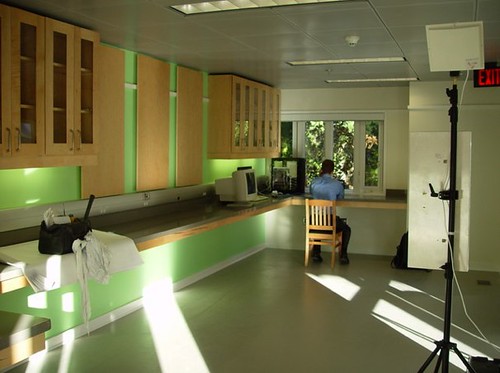
Smart Home, a live-in laboratory at Duke University, is a place where inter-disciplinary research meets practical needs.

After having won one of the most prestigious ratings in green buildings, called the Platinum LEED rating (given by the US Green Building Council), Smart Home has established itself as a foremost example of focusing holistic research on sustainable building techniques. Students from many majors continuously work in groups on projects for the Smart Home and compete for the Will Senner Grants Award Competition and the Cisco Innovation Award.

One of the interesting projects that won the Will Senner Grants Award Competition late last year was an all-freshman team whose research focuses on tapping the vast potential of the sophisticated lighting system of the Smart Home.

The ambitious goal is to work on the lines of sustainability and greatly reduce the wastage of light and energy in homes. Some of the immediate subprojects include a night light system- a system in which if a resident arrives late at night, the path to his room can be lit so as to avoid disturbing other residents with excessive light; measuring the REM sleep cycle of the person so that the lights and other electronic equipment can instantly switch off once the person is asleep, thereby saving huge amounts of energy; a light notification system that is directly connected to the door bell, so that instead of creating noise by ringing the bell, the residents can be notified of visitors through a subtler system of flashing of lights; night time protection that will systematically and logically turn lights on and off to mimic the presence of someone in home all the time, even during vacation, hence provides protection.

The research narrows down to the fact that through the power of fuzzy logic, the programmable lights in Smart Home can be made to fulfill several functions that can enhance day-to-day lights as well as provide a further step in promoting sustainability.

Monday, January 12, 2009

Student's research provides insights into alcohol addiction


Kapil Ramachandran, 17, is a freshman at Duke who's scientific career has already won him national acclaim.

At age 16, his research about alcohol addiction won him a prestigious award at the Intel International Science and Engineering Fair. According to Kapil, his innovative research was inspired by his experiences while working in the emergency room of a hospital.

"I saw a patient come in who had overdosed on alcohol and narcotics. I thought, 'Why would anyone do that to themselves? How could they become so addicted to something that they're willing to risk their life for it?' That's what switched me on."

Kapil looked for labs in his hometown, Austin, Texas, that were conducting research about addiction. He found a lab that was integrating behavior and molecular biology, and began his research.

"I had to figure out a suitable model organism to work with. I picked fruit flies because they are very easily manipulable in terms of genetics. It's easy to create them; they have a limited number of chromosomes and reproduce quickly."

"First, I had to survey genes that could have been implicated in addiction. The search was actually a random systematic search. I picked a chromosome and I started deleting chunks of it. I took an entire chromosome and every 12 genes I would excise out 12 genes."

This search yielded 600 to 700 lines of flies. During the excision process, Kapil also developed a behavioral test to measure their tolerance of alcohol. When he ran all the lines of flies through the test, he found that only one or two groups did not show tolerance. He examined these groups to see what genes they had in common. From there, he narrowed in on the family of genes, and then to specific genes and proteins.

Although Kapil conducted his experiment on fruit flies, it has many implications for the future treatment of alcohol addiction in humans.

"The project was fully independent. My professor and my coworkers taught me the techniques, but other than that, the research, the ideas were mine."

"[My parents] put up with me not being home until 3 a.m. I was at the lab 11 hours a day ... I worked my ass off."

Kapil was awarded the prize in May 2008, the day before his birthday. In addition to recognition for his efforts, he received $15,000.

"That was some nice cash in the bag the day before my birthday," Kapil said. What is he using the money for? "I'm coming here," he laughs. (Photo: Kapil with Elias Zerhouni, director of the National Institutes of Health.)

"It's awesome. Without a doubt. I love this place. Basketball is #1- there's no atmosphere like Cameron. And the people I've met here. There's such a wide variety of people, it's incredible. And they're so freaking smart."

It's an impressive compliment, coming from one as successful as himself.

Tuesday night, Kapil will be talking about his work at Periodic Tables Durham's entry into the science cafe movement -- a social event for science-minded adults that provides information and discussion about the latest scientific research.

Sunday, December 21, 2008

3D Cancer Detection

Biomedical engineers and cancer specialists at Duke have long been collaborating to discover ways to detect and treat cancer at all its stages. One of the recent major breakthroughs is the ability to observe and examine a live body tissue in three dimensions using a technique called Multi-photon microscopy.

According to researchers, more than 50% of all detected cancers arise in squamous epithelium, and if detected in a pre-invasive or pre-cancerous state, it can be treated relatively well.

The team led by Dr. Nirmala Ramanujam, Associate Professor of BME at Duke, has been studying optical spectroscopy, optical sectioning microscopy and photon migration techniques, and attempting to use them for characterizing and detecting biochemical and structural properties of various human tissues. According to Dr.Ramanujam, the multi-photon fluorescence microscopy—a technique enables doctors to "peer into the individual cells in a very non-invasive way to see how things change as early cancer progresses."

A multiphoton fluorescence microscope uses pulsed long wavelength laser light to excite fluorophores within a specimen. The fluorophore absorbs the energy from two long-wavelength photons that must arrive simultaneously in order to excite an electron into a higher energy state, from which it can decay, emitting a signal.

Another technique being explored by Ramanujam's group is called Ultraviolet-visible optical spectroscopy (UV-VIS). It is similar to fluorescence spectroscopy, in a way that fluorescence involves transitions from the excited state to the ground state, while absorption deals with electron transitions from the ground state to the excited state.

Dr. Ramanujam's current focus is on further researching and developing broad and effective techniques for clinical detection of cancer.