Showing posts with label nanotechnology. Show all posts

Friday, November 13, 2009

Duke Forest, by the numbers

Most laboratories at Duke are described in terms of square feet. But the Duke Forest, which performs about $3 million worth of research every year, is best appreciated in square miles -- more than 11 of them -- scattered across three counties.

(image: Professor James Clark works on his soil warming experiment| Megan Morr, Duke Photo)

Resource manager Judd Edeburn brought the forest's friends and neighbors up to date with activities in the forest during an informal annual meeting Thursday night at the New Hope Improvement Association Center, adjacent to the heavily-used Korstian Division. (Duke Forest Map, PDF) About 60 grad students, staff and trekkers noshed while Judd described the latest victories and challenges.

Victories: Education and research. More than 2,000 students from across North Carolina use the forest each year for research projects and field trips. Current research includes, of course forestry and wildlife management, but also climate change and nanotechnology.

About 1 million board feet is harvested each year to maintain healthy diversity and produce about 85 percent of the forest's operating budget. "Most of the forest, because of its past use as agricultural land, the dominant component is pine timber," Edeburn said. About half of the forest is off limits to logging as well, so-called "heritage sites," like that around the scenic New Hope Creek. The forest could sustain an annual harvest of 2.5 to 3 million board feet, but never has. Timber prices are low right now anyway, he said.

Challenges: Kudzu vine has been spotted, which is probably manageable, but a mini-bamboo grass called microstegium is running rampant. Some giant herbivores called white-tailed deer are rampant too, occurring at a density of 60 animals per square mile -- up to 80 in some spots -- when wildlife biologists recommend more like 15-20/mile to keep everything in balance.

The forest has started allowing hunters to take some deer, under carefully controlled conditions, and experiments are being run to fence off some areas to see just how much difference deer make, but fencing the entire collection of woods would be ridiculously difficult and expensive, Edeburn said.

There was some outcry when the deer hunt was introduced last year, but Duke Forest staff kept careful track of every comment they received and found that the largest response by far was "where can I hunt?"

Monday, March 2, 2009

Engineering Futuristic Medicine


Massachusetts Institute of Technology professor Robert Langer gave a National Academy of Engineering summit focused on addressing worldwide needs a primer on how engineers can aid medicine.

One big challenge is figuring how to get "drugs of the future" into the human body in a way that can do some good, said the chemical engineer who won the 800,000 Euro 2008 Millenium Technology Prize for some of his innovations. Langer himself has "found over 200 different ways to get that not to work," he said in an address on Monday, March 9 at the Durham Performance Art Center.

The problem is that such large molecular weight drugs -- such as hormones, proteins, peptides and forms of DNA -- must reach targets such as a pancreatic cell in diabetes treatment or a tumor cell in cancer therapy without being chewed up by the body's own biochemistry. One successful stratagem his group has pioneered is placing the drug inside a protective polymer coat.
Another idea is designing polymers that be threaded though tiny bodily passages and then shift their shapes at internal body temperatures.

Langer's team has also created polymer scaffolds that experiments show may be usable to nurture cells needed to repair burned tissue, grow new noses or ears, even repair damaged spinal chords.

Engineering Solutions for the World's 21st Century Challenges


Engineers and scientists -- including social scientists -- need to work together and urgently to address 14 engineering challenges identified as crucial to Earth's future last year by the National Academy of Engineering, said academy director Charles Vest in a March 2 kickoff address at the Durham Performance Arts Center during the first session of a summit on those problems.

Panels of experts have compartmentalized those challenges into six broad areas, Vest said at the two-day event, hosted by Duke University, the University of Southern California's Viterbi School of Engineering and Franklin W. Olin College of Engineering. Those include energy use, addressing global warming, maintaining sustainability, delivering health care, security against human and natural threats, and developing ways to enhance human capability and joy.

Speaking as a snowstorm was moving up the East Coast and the stock market continued to nosedive in a face of dire and worldwide economic news, Vest remained upbeat. "I believe this is the most exciting time in human history to be engaged with science and engineering," he said. But to harness that excitement, engineering educators also need to revamp curricula to lure more socially committed youth to major in engineering, he added.

A. Paul Alivisatos, the interim director of the Lawrence Berkeley National Laboratory, said he has noticed a startling turnaround of student interest in helping resolve such issues as climate change and such consequences as the potential for geopolitical conflict due to competition for water, land and other resources.

Alivisatos concentrated on another hot button issue, energy use, which he said contrary to public perception does not always increase as nations get wealthier. For example, the State if California's overall energy use actually held steady when compared to domestic outputs after new state standards stimulated new industry innovations in refrigerator efficiencies.

Alivasatos, who replaced Nobel Laureate Steven Chu at Lawrence Berkeley after Chu became Energy Secretary, also described new research efforts to boost efficiencies of collecting the sun's energy by developing solar cells made of nanocrystals or plastics and temporarily storing that energy in molecules like Nature does in photosynthesis.

Robert Socolow, a professor of chemistry, materials science and nanoscience at Princeton University, said successes at building large scale power grids are considered the number one grand engineering achievement of the 20th century. But the goal for the 21st century is not to significantly expand that power capacity but rather improve the efficiency of what exists now with techniques such as recycling waste heat. Tapping nuclear fusion will be a "century-long challenge," and building more nuclear fission power plants a shorter one, Socolow predicted.

Meanwhile, technology is already being developed to remove carbon dioxide from industrial exhausts and store it underground so it can't contribute to global warming, he said. A new challenge will be to regulate the proliferation of nitrogen in a way analogous to CO2, perhaps by engineering more plants to produce it instead of relying on industrial fertilizers.

Thursday, November 6, 2008

DNA Waffles. Do not Eat.

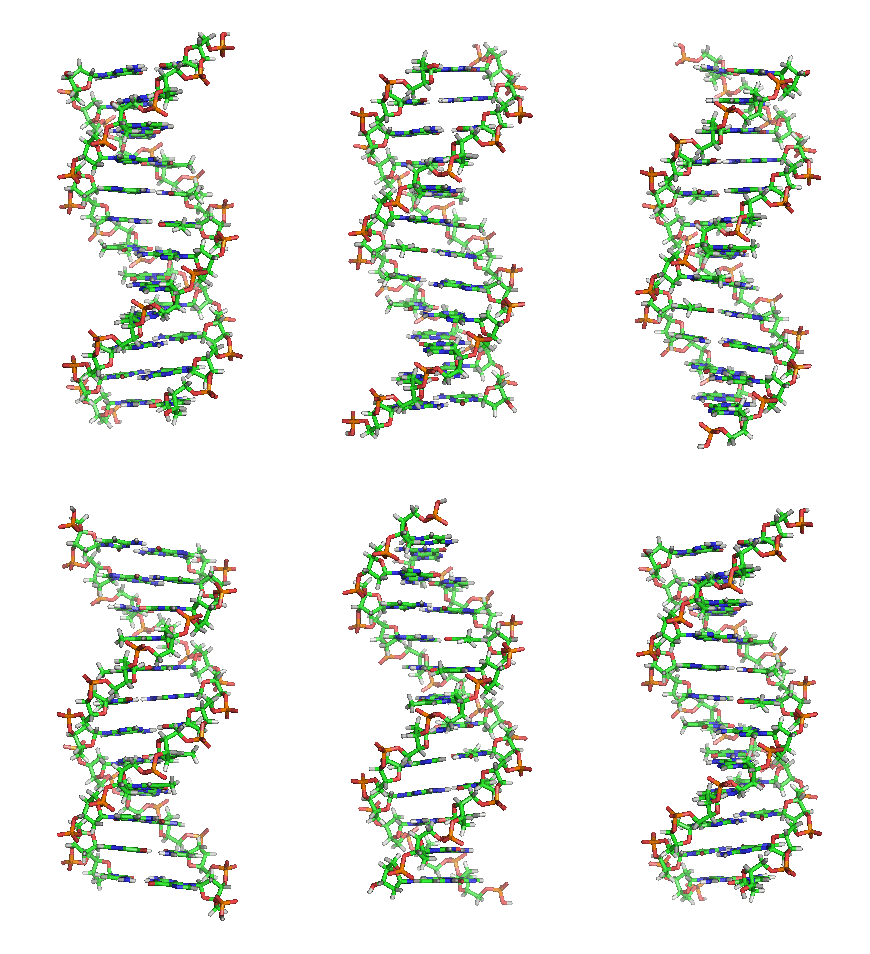
For researchers at Duke University, a waffle does not just refer to an absolutely amazing thing to eat for breakfast, but in fact represents an innovative structure of DNA strands.


A DNA waffle or a nano waffle is basically a system of DNA strands that are locked together into tiles. When these individual square and cross-shaped tiles are inter-locked together, they resemble a waffle grid.

The great thing about manipulating DNA strands into such a grid is that these sets of tiles can self-assemble into lattices, for example, a template for a precise silver nanowire. A nanowire can be used to connect microscopic objects, to create nanoscale structures. DNA acts an effective template as it other elements can form chemical connections with different positions on a DNA strand. Thus they provide a perfect base for positioning the molecules at exact positions, reducing the level of uncertainty. Hence these kind of DNA structures can be used to hold together a set of molecules, which can self-assemble into pre-programmed configurations.


"The way we've designed these is by changing the sequence of DNA molecules so that they basically tie themselves into knots, and the designs of the knots fit into this sort of pattern." says Chris Dwyer, assistant professor in the Department of Electrical & Computer Engineering.


Apart from interconnecting microscopic objects, self-assembled DNA structures like DNA waffles can be useful in making various types of new materials with all the desired properties even at the molecular level. Such structures may play a significant part in the development of DNA computers in the coming years.