Monday, November 10, 2008

Shortcomings of Medical Donations


Studies show that 80 percent of the medical equipment reaching developing nations' hospitals is donated but 70 percent of those donations don't work. Such shortcomings could explain why the world's medical communities' failed in their goals to deliver health care everywhere by the 21st century, said Robert Malkin, a Duke professor for the practice of biomedical engineering who also directs a voluntary program called Engineering World Health.

Malkin analyzed why nearly 3,000 pieces of such technology failed to work correctly during a Nov. 7 talk at a Duke conference on Bioengineering Applications to Address Global Health. Some widely-touted reasons, such as a lack of spare parts or an inability to train local staff to use the equipment, appear to actually be off the mark, he said.

One of the biggest real problems is hospitals' inability to replace disposable items connected the technology in places where the per-patient outlays for such "consumables" cannot exceed 34 cents, he said. Spare parts may be less of an issue than access to the right tools, he added. And staffs that might appear confused in training may really need access to manuals in the right language.

Malkin's own Engineering World Health (EWH) project sends volunteer engineers to work alongside hospital administrators to evaluate equipment needs. Those needs are then met with donated equipment.

After that, engineering and science students from Duke and other universities visit those hospitals after undergoing language and technical training in Costa Rica or Tanzania. Once on location, the students work on equipment repair and installation. And the voluntary engineers also make followup visits to make sure everything is working properly.

Between 2003 and 2007 EWH has put 1,623 pieces of equipment --- $3 milllion worth -- into service, Malkin said.

Giving Women Control Against HIV


HIV, the AIDS virus, "targets women with Darwinian ferocity," says Patrick Kiser, an assistant biomedical engineering professor at the University of Utah who got his Ph.D. at Duke. In Africa, the HIV infection rate among young women can be three times higher than men.

That's in part because females are at the "receiving end" of HIV-infected semen and partly because of their vulnerable societal status, Kiser said Nov. 6 at a Duke conference on Bioengineering Applications to Address Global Health. So while male use of condoms can prevent transmission, that requires far-from-certain negotiating between sexual partners.

Kiser's lab is working on techniques that would shift control to women by introducing agents called "microbiocides" to stop the virus cold in the vagina. But early experiments by others have not been promising, he said.

While one candidate gel preparation seemed to block the virus in laboratory culture, for example, the salt content of semen interfered with the agent's effectiveness. Also, women did not always follow instructions that called for applications before each sex act.

His group's tactic is to combine advanced microbiocides more attuned to bodily chemistries with better drug delivery techniques. As one example, it is developing flexible plastic intravaginal rings that can be made for pennies and deliver a constant amount of microbiocide for 30 days.

One gel method of action he described would trigger the release of anti-HIV drug when normally acidic vaginal fluids undergo a pH change upon intercourse (sperm is basic rather than acidic). At the same time, the normally free-flowing gel would chemically crosslink into a semi-solid to stop viral particles from reaching vulnerable white blood cells of the immune system.

Kiser is also collaborating with a Duke group headed by biomedical engineering professor David Katz.

Friday, November 7, 2008

Get LINKed in

The newly-designed LINK, located on the lower level of the Perkins Library, has 6 classrooms, 4 seminar rooms, and 11 group study rooms, all equipped with projectors, flat-screen televisions, and wall-to-wall whiteboards. It has a slick, colorfully modern design with orange, white, purple, and metallic elements, complemented by extensive windows. I really like the style of the place-- it’s certainly a change from the typical classroom environment.

One of my classes is held in a seminar room of the LINK. There’s one big conference table in the center, ringed by chairs. There’s also two full walls of whiteboard space; the rest is windows. My teacher can use a touch screen to lower the projector screen, turn on the projector, and dim the lights. She says she’d love to teach in the LINK again next year, because it has been so helpful for teaching the class.

The various classroom spaces are centered around the Office of Information and Technology (OIT) help desk. The desk is staffed by technological genii and trained students, who are equipped to help people with technology-related problems. Also at the desk, students and faculty can borrow cameras, iPods, and other technology for a two-week period as easily as they would a library book. This service, made possible by the Duke Digital Initiative (DDI), is incredibly useful. A few weeks ago I was able to check out a sleek little FlipCam from DDI for a documentary assignment. It’s nice to have access to this kind of technology on an as-needed basis, and without having to pay.

The LINK also has Windows and Mac computer clusters for student use. These computers are loaded with useful programs, including statistical and geographic information system (GIS) software that is only available in a few other places on campus. I’ve used a GIS program on the Macs. The Windows and Mac computers in the LINK all have gloriously huge monitors, which makes them pretty fun and efficient to use.

However, what students seem to appreciate most about the LINK is the ample study space. The comfortable chairs and booths are all very popular, either for study, snacking, or sleep. I can certainly vouch for the funky purple chairs; they’re one of my favorite places to study.


The group study rooms provide a great space for collaborating on projects or studying for tests. Students can use the expansive whiteboard space for a variety of purposes, from diagramming molecules to declining French verbs. I’ve even seen a whiteboard used for an epic cartoon battle of Godzilla versus Pikachu. All told, the LINK is an innovative academic environment that promises to enhance students’ learning experiences.

Thursday, November 6, 2008

DNA Waffles. Do not Eat.

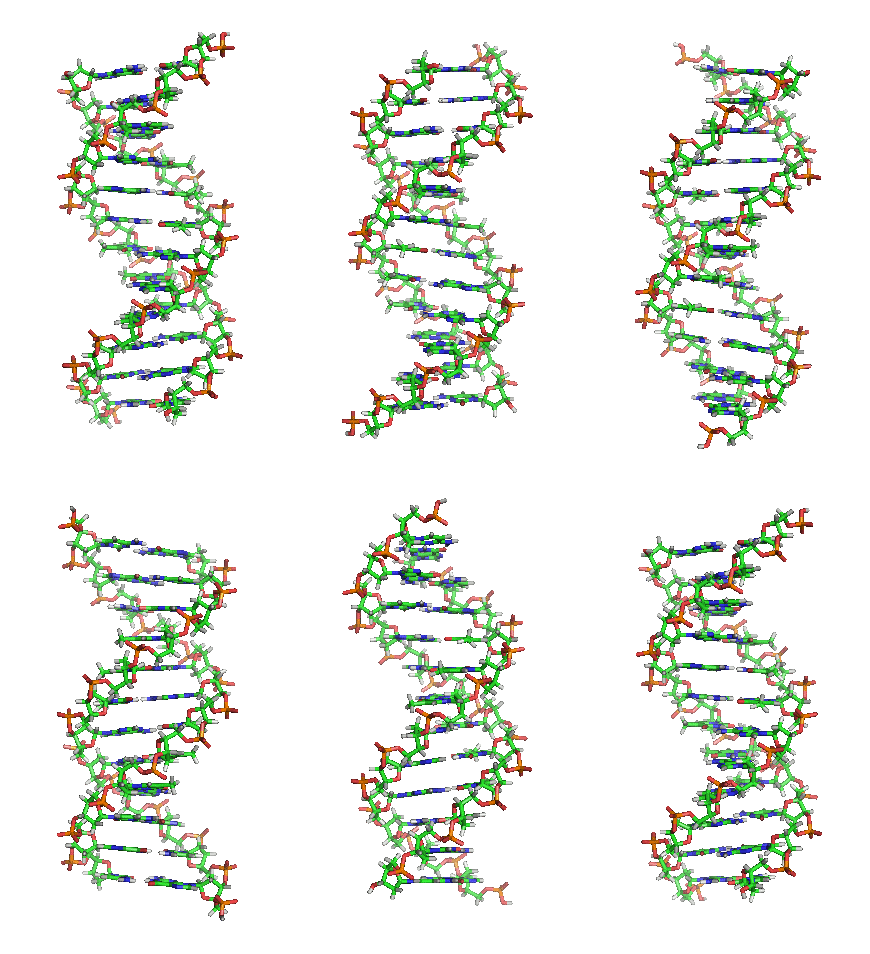
For researchers at Duke University, a waffle does not just refer to an absolutely amazing thing to eat for breakfast, but in fact represents an innovative structure of DNA strands.


A DNA waffle or a nano waffle is basically a system of DNA strands that are locked together into tiles. When these individual square and cross-shaped tiles are inter-locked together, they resemble a waffle grid.

The great thing about manipulating DNA strands into such a grid is that these sets of tiles can self-assemble into lattices, for example, a template for a precise silver nanowire. A nanowire can be used to connect microscopic objects, to create nanoscale structures. DNA acts an effective template as it other elements can form chemical connections with different positions on a DNA strand. Thus they provide a perfect base for positioning the molecules at exact positions, reducing the level of uncertainty. Hence these kind of DNA structures can be used to hold together a set of molecules, which can self-assemble into pre-programmed configurations.


"The way we've designed these is by changing the sequence of DNA molecules so that they basically tie themselves into knots, and the designs of the knots fit into this sort of pattern." says Chris Dwyer, assistant professor in the Department of Electrical & Computer Engineering.


Apart from interconnecting microscopic objects, self-assembled DNA structures like DNA waffles can be useful in making various types of new materials with all the desired properties even at the molecular level. Such structures may play a significant part in the development of DNA computers in the coming years.